
2027 VA Disability Pay Chart & Rates: 3.6% COLA Increase
Posted by Gregory M. Rada | October 15, 2026 | Disability Compensation
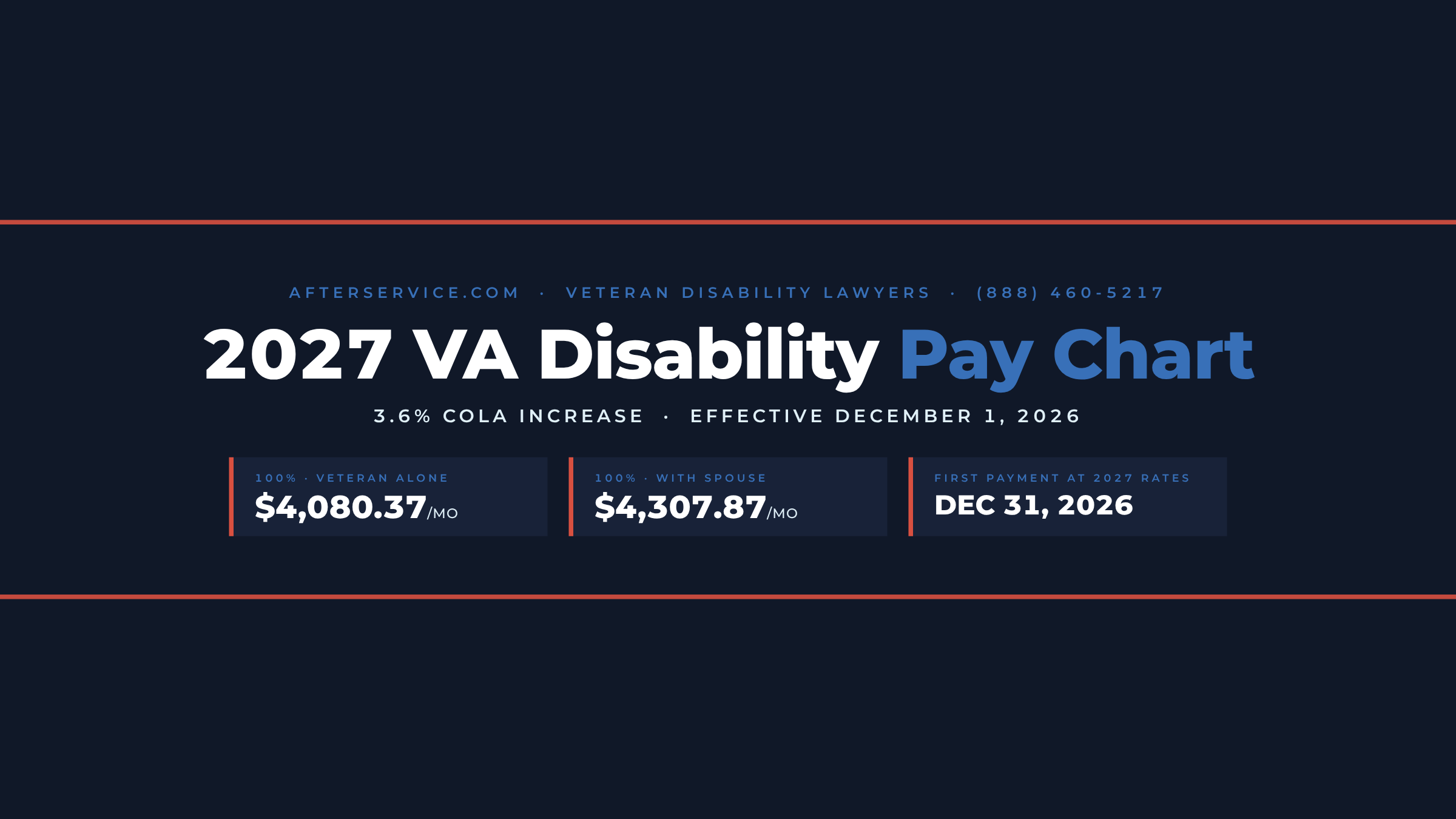
On October 14, 2026, the Social Security Administration announced a 3.6% cost-of-living adjustment (COLA) for 2027, and the 2027 VA disability compensation rates rise by the same percentage. The new rates take effect December 1, 2026, with the first payment at the higher rate arriving on December 31, 2026. A veteran rated at 100% with no dependents will now receive $4,080.37 per month, an increase of $141.79.
Below is the full 2027 VA disability pay chart: the basic monthly rates from 10% to 100%, every dependent combination (spouse, children, and parents), the 2027 SMC rates, the TDIU rate, the 2027 payment dates, and a quick way to estimate your own new payment.
2027 VA disability rates at a glance
- 2027 COLA: 3.6%, the largest increase since 2023
- Effective date: December 1, 2026
- First payment at the new rate: Thursday, December 31, 2026
- 100% rating, veteran alone: $4,080.37 per month (up $141.79)
- 100% rating with a spouse: $4,307.87 per month
- 10% rating: $186.92 per month (up $6.50)
- TDIU: paid at the 100% rate, $4,080.37 per month plus any dependent add-ons
What’s changing in 2027 (3.6% COLA)
Every year, VA disability compensation rates are increased by the same percentage as Social Security benefits. The adjustment comes from the Consumer Price Index for Urban Wage Earners and Clerical Workers (CPI-W). The Social Security Administration compares the average CPI-W for July, August, and September 2026 with the same three months of 2025, and the difference becomes the COLA. For 2027 that number translates to a 3.6% increase.
That is the largest adjustment in four years. The COLA was 2.8% for 2026, 2.5% for 2025, and 3.2% for 2024. The last time it was higher was the 8.7% increase for 2023.
The 3.6% increase applies across VA’s compensation programs: disability compensation at every rating from 10% to 100%, the dependent add-ons for ratings of 30% and higher, Special Monthly Compensation (SMC), Dependency and Indemnity Compensation (DIC) for surviving spouses and children, and VA pension. Importantly, veterans do not need to apply for the increase or contact the VA because it is applied automatically.
Congress ties VA rates to the Social Security COLA through legislation each year. The Veterans’ Compensation Cost-of-Living Adjustment Act of 2026 (H.R. 8552 and S. 4487) sets the effective date as December 1, 2026. Congress has passed this bill every year, and the VA has applied the increase on December 1st each year (again, payable on December 31st).
VA publishes its official rate tables after the COLA is announced, but it has not yet updated its website. So, the 2027 rates on this page are calculated from the official 3.6% COLA using VA’s rounding rules. If the VA’s official 2027 tables differ from these figures in any respect when VA publishes them, this page will be updated.
When your higher payment arrives
The VA pays disability compensation in arrears, so the benefit for any given month is paid on the first business day of the following month, and when the first of the month falls on a weekend or federal holiday, the payment arrives on the last business day before it. December 2026 is the first month paid at the 2027 rate. Because January 1, 2027 is a Friday and a federal holiday, that payment is scheduled for Thursday, December 31, 2026.
Remember, the payment that arrives on December 1, 2026, covers November 2026 and will still be at the 2026 rate. The full 2027 payment schedule is below.
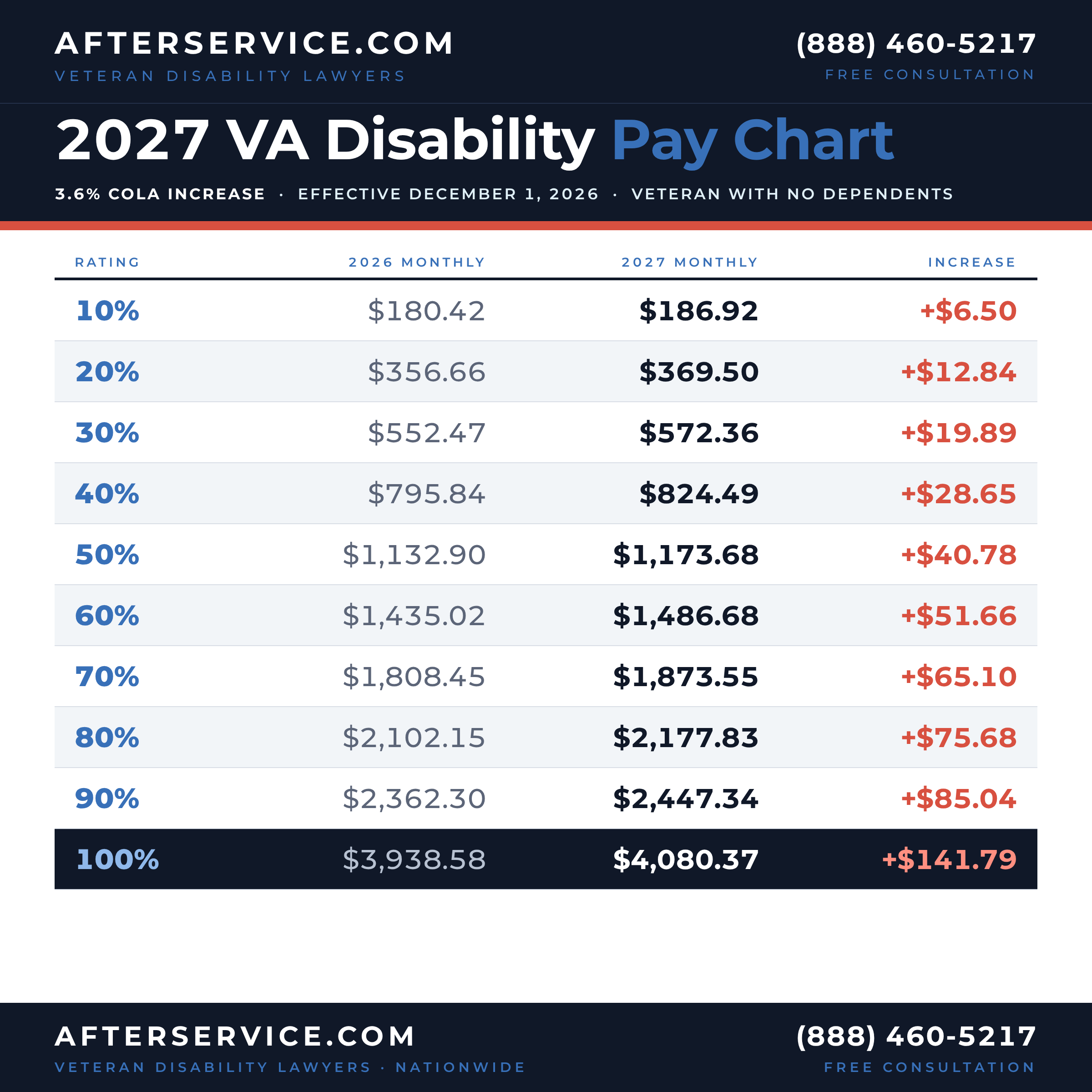
2027 VA disability pay chart (veteran alone)
These are the 2027 monthly rates for a veteran with no dependents. Ratings of 10% and 20% do not receive dependent add-ons. Ratings of 30% and higher do, and those amounts are in the dependent charts that follow.
| Disability Rating | 2026 Monthly Rate | 2027 Monthly Rate | Increase |
|---|---|---|---|
| 10% | $180.42 | $186.92 | +$6.50 |
| 20% | $356.66 | $369.50 | +$12.84 |
| 30% | $552.47 | $572.36 | +$19.89 |
| 40% | $795.84 | $824.49 | +$28.65 |
| 50% | $1,132.90 | $1,173.68 | +$40.78 |
| 60% | $1,435.02 | $1,486.68 | +$51.66 |
| 70% | $1,808.45 | $1,873.55 | +$65.10 |
| 80% | $2,102.15 | $2,177.83 | +$75.68 |
| 90% | $2,362.30 | $2,447.34 | +$85.04 |
| 100% | $3,938.58 | $4,080.37 | +$141.79 |
| TDIU (paid at the 100% rate) | $3,938.58 | $4,080.37 | +$141.79 |
At 100%, the 2027 rate works out to $48,964.44 per year for a veteran with no dependents, before any Special Monthly Compensation or dependent add-ons. For prior-year figures, see the 2026 VA disability pay chart.
2027 VA disability pay charts with dependents
Veterans who have a 30% rating or higher receive additional compensation for a spouse, dependent children, and dependent parents. The dependent add-ons increase with the rating: at 100% the spouse add-on is $227.50 per month, while at 30% it is $68. The tables below give the full 2027 monthly payment for each combination, so you can look up your own rate directly.
30% to 60% ratings: with a spouse or dependent parents (no children)
| Dependent status | 30% | 40% | 50% | 60% |
|---|---|---|---|---|
| Veteran alone (no dependents) | $572.36 | $824.49 | $1,173.68 | $1,486.68 |
| With spouse (no parents or children) | $640.36 | $915.49 | $1,286.68 | $1,622.68 |
| With spouse and 1 parent (no children) | $694.36 | $988.49 | $1,377.68 | $1,731.68 |
| With spouse and 2 parents (no children) | $748.36 | $1,061.49 | $1,468.68 | $1,840.68 |
| With 1 parent (no spouse or children) | $626.36 | $897.49 | $1,264.68 | $1,595.68 |
| With 2 parents (no spouse or children) | $680.36 | $970.49 | $1,355.68 | $1,704.68 |
70% to 100% ratings: with a spouse or dependent parents (no children)
| Dependent status | 70% | 80% | 90% | 100% |
|---|---|---|---|---|
| Veteran alone (no dependents) | $1,873.55 | $2,177.83 | $2,447.34 | $4,080.37 |
| With spouse (no parents or children) | $2,032.55 | $2,359.83 | $2,651.34 | $4,307.87 |
| With spouse and 1 parent (no children) | $2,159.55 | $2,505.83 | $2,815.34 | $4,490.45 |
| With spouse and 2 parents (no children) | $2,286.55 | $2,651.83 | $2,979.34 | $4,673.03 |
| With 1 parent (no spouse or children) | $2,000.55 | $2,323.83 | $2,611.34 | $4,262.95 |
| With 2 parents (no spouse or children) | $2,127.55 | $2,469.83 | $2,775.34 | $4,445.53 |
30% to 60% ratings: with children
The “with children” tables include one child. For each additional child, add the amount from the added amounts table.
| Dependent status | 30% | 40% | 50% | 60% |
|---|---|---|---|---|
| Veteran with 1 child only (no spouse or parents) | $617.36 | $884.49 | $1,249.68 | $1,577.68 |
| With 1 child and spouse (no parents) | $690.36 | $981.49 | $1,370.68 | $1,722.68 |
| With 1 child, spouse, and 1 parent | $744.36 | $1,054.49 | $1,461.68 | $1,831.68 |
| With 1 child, spouse, and 2 parents | $798.36 | $1,127.49 | $1,552.68 | $1,940.68 |
| With 1 child and 1 parent (no spouse) | $671.36 | $957.49 | $1,340.68 | $1,686.68 |
| With 1 child and 2 parents (no spouse) | $725.36 | $1,030.49 | $1,431.68 | $1,795.68 |
70% to 100% ratings: with children
| Dependent status | 70% | 80% | 90% | 100% |
|---|---|---|---|---|
| Veteran with 1 child only (no spouse or parents) | $1,979.55 | $2,298.83 | $2,583.34 | $4,232.51 |
| With 1 child and spouse (no parents) | $2,148.55 | $2,492.83 | $2,801.34 | $4,474.47 |
| With 1 child, spouse, and 1 parent | $2,275.55 | $2,638.83 | $2,965.34 | $4,657.05 |
| With 1 child, spouse, and 2 parents | $2,402.55 | $2,784.83 | $3,129.34 | $4,839.63 |
| With 1 child and 1 parent (no spouse) | $2,106.55 | $2,444.83 | $2,747.34 | $4,415.09 |
| With 1 child and 2 parents (no spouse) | $2,233.55 | $2,590.83 | $2,911.34 | $4,597.67 |
Added amounts: additional children and spousal Aid and Attendance
Add these amounts to the figures above for each additional child under 18, for each child between 18 and 23 who is enrolled in a qualifying school program, and when a spouse needs the regular aid and attendance of another person.
| Added monthly amount | 30% | 40% | 50% | 60% |
|---|---|---|---|---|
| Each additional child under age 18 | $33 | $45 | $56 | $67 |
| Each additional child over age 18 in a qualifying school program | $109 | $146 | $182 | $219 |
| Spouse receiving Aid and Attendance | $62 | $83 | $105 | $125 |
| Added monthly amount | 70% | 80% | 90% | 100% |
|---|---|---|---|---|
| Each additional child under age 18 | $79 | $90 | $101 | $113.04 |
| Each additional child over age 18 in a qualifying school program | $255 | $292 | $328 | $365.14 |
| Spouse receiving Aid and Attendance | $146 | $166 | $188 | $208.66 |
How dependent add-ons work (and why veterans miss them)
VA does not automatically add dependents to an award. A veteran has to tell the VA about a spouse, child, or dependent parent by filing a VA Form 21-686c (Declaration of Status of Dependents), which can be filed online through VA.gov. A child generally counts until age 18, until age 23 while enrolled in an approved school, and indefinitely if the child became permanently incapable of self-support before turning 18.
Two situations come up often. In the first, a veteran is rated 30% or higher but never added a spouse or children, and has been paid at the “veteran alone” rate for years. In the second, a dependent was added but a later change (a marriage, a birth, a divorce, a child aging out) was never reported, so the award is wrong in one direction or the other. Depending on when the dependent was added and when the VA was notified, VA may owe retroactive dependent benefits, or it may have overpaid and the veteran will have to repay that amount to VA. If your payment does not match the chart for your rating and family situation, it is worth figuring out why. Our guide to VA disability back pay and effective dates explains how retroactive payments are calculated.
TDIU pays at the 100% rate
A Total Disability rating based on Individual Unemployability (TDIU) pays at the 100% rate even though a veteran’s combined rating is below 100%. In 2027 that is $4,080.37 per month for a veteran alone, and the same dependent add-ons apply.
| 100% or TDIU, by dependent status | 2026 monthly rate | 2027 monthly rate | Monthly increase |
|---|---|---|---|
| Veteran alone | $3,938.58 | $4,080.37 | +$141.79 |
| With spouse | $4,158.17 | $4,307.87 | +$149.70 |
| With spouse and 1 child | $4,318.99 | $4,474.47 | +$155.48 |
| With 1 child (no spouse) | $4,085.43 | $4,232.51 | +$147.08 |
| With spouse and 1 parent | $4,334.41 | $4,490.45 | +$156.04 |
| With spouse, 1 child, and 1 parent | $4,495.23 | $4,657.05 | +$161.82 |
TDIU is available when service-connected conditions prevent a veteran from maintaining substantially gainful employment. And it is important to remember that a veteran does not need to meet the schedular requirements of 38 C.F.R. § 4.16(a) (one condition rated 60% or higher, or a combined rating of 70% or higher with at least one condition rated 40%) because veterans who do not meet those percentages can still qualify for extraschedular TDIU under § 4.16(b).
One point that is easy to overlook: TDIU does not always have to be claimed on its own form. When the record shows that a veteran cannot work because of service-connected conditions, a claim for a TDIU can be reasonably raised by the record, and if VA never decided it, the veteran may be entitled to a TDIU from an earlier effective date. That is why our TDIU reviews include reading every page of the claims file to identify implicit claims for TDIU. We handle TDIU appeals nationwide, and our post on the TDIU income limits explains how the VA treats earnings while a veteran receives TDIU.
2027 SMC rates
Special Monthly Compensation (SMC) is paid for specific severe disabilities and circumstances, including the loss or loss of use of a limb, blindness, the need for regular aid and attendance, and being housebound. SMC rates also rise 3.6% for 2027. The table below shows the rate for a veteran with no dependents. Dependent add-ons for SMC recipients are the same as the add-ons at the 100% rate and are paid in addition to the SMC rate.
| SMC level | Generally paid for | 2026 monthly rate (veteran alone) | 2027 monthly rate (veteran alone) |
|---|---|---|---|
| SMC-K | Loss, or loss of use, of a hand, foot, creative organ (ED or female sexual arousal disorder), or other specific anatomical loss. Paid in addition to the regular rating (up to three SMC-K awards). | $139.87 | $144.91 |
| SMC-S | Housebound: a single 100% rating plus separate ratings combining to 60% or more, or being substantially confined to the home because of service-connected disability. | $4,408.53 | $4,567.24 |
| SMC-L | Regular aid and attendance of another person, loss of use of both feet or of one hand and one foot, blindness in both eyes with 5/200 visual acuity or less, or being permanently bedridden. | $4,900.83 | $5,077.26 |
| SMC-L 1/2 | Intermediate rate between L and M. | $5,154.00 | $5,340.00 |
| SMC-M | Loss of use of both hands, both legs at or above the knee, one arm and one leg, or other combinations at the M level. | $5,408.55 | $5,603.26 |
| SMC-M 1/2 | Intermediate rate between M and N. | $5,780.00 | $5,988.00 |
| SMC-N | Loss of use of both arms at the elbow, both legs at the hip, or other combinations at the N level. | $6,152.64 | $6,374.14 |
| SMC-N 1/2 | Intermediate rate between N and O/P. | $6,514.00 | $6,749.00 |
| SMC-O/P | The most severe combinations of anatomical losses, for example loss of use of both hands and both feet, or total blindness together with total deafness. | $6,877.12 | $7,124.70 |
| SMC-R.1 | SMC-O or P entitlement plus the need for regular aid and attendance. | $9,826.88 | $10,180.65 |
| SMC-R.2/T | R.2: the need for a higher level of care from a licensed provider, without which the veteran would require hospitalization or nursing-home care. T: a traumatic brain injury requiring aid and attendance where the veteran would otherwise need institutional care. | $11,271.67 | $11,677.45 |
| SMC-Q | A fixed statutory amount for certain veterans with arrested tuberculosis. Not adjusted for the COLA. | $67.00 | $67.00 |
SMC-K is paid in addition to the regular rating. SMC-S and the higher levels replace the 100% rate rather than adding to it. The highest rate, SMC-R.2/T, is explained in detail in our post on SMC-T for TBI veterans.
2027 VA disability payment dates
The VA pays each month’s benefit on the first business day of the following month. Below are the scheduled payment dates for the 2027 rate year.
| Benefit month | Payment date |
|---|---|
| December 2026 | Thursday, December 31, 2026 (first payment at 2027 rates) |
| January 2027 | Monday, February 1, 2027 |
| February 2027 | Monday, March 1, 2027 |
| March 2027 | Thursday, April 1, 2027 |
| April 2027 | Friday, April 30, 2027 |
| May 2027 | Tuesday, June 1, 2027 |
| June 2027 | Thursday, July 1, 2027 |
| July 2027 | Friday, July 30, 2027 |
| August 2027 | Wednesday, September 1, 2027 |
| September 2027 | Friday, October 1, 2027 |
| October 2027 | Monday, November 1, 2027 |
| November 2027 | Wednesday, December 1, 2027 |
| December 2027 | Friday, December 31, 2027 (first payment at 2028 rates) |
Direct deposits usually post on the scheduled date, although some banks make funds available a day or two early. Paper checks take longer, so veterans are encouraged to sign up for direct deposit.
How to estimate your new monthly payment
Multiply your current monthly payment by 1.036. A veteran paid $1,808.45 at 70% with no dependents, for example, will receive $1,873.55 in 2027. The multiplier works for any single rate, including SMC. If you have dependents, use the tables above rather than the multiplier, because the VA rounds each dependent add-on separately and the result can differ from a straight 3.6% increase by a dollar or so.
The increase you see in your account may not match the chart exactly if VA is withholding part of your compensation. Common reasons include the recoupment of military separation pay or a severance payment, an earlier overpayment, drill pay for reservists, an apportionment to a dependent, or the concurrent-receipt rules that apply to military retirees (CRDP and CRSC).
If your rate doesn’t look right
A COLA keeps compensation in step with prices, but it does not reflect a condition that has gotten worse, a secondary condition that was never claimed, or an inability to keep working. Those situations require a claim for an increased rating, a secondary service connection claim, or a TDIU claim, or if the VA has already decided the issue, an appeal through the right lane. Our guides on how to appeal a VA disability decision and appealing a low VA disability rating walk through your options.
Effective dates matter as much as the rating. Back pay is calculated at the rate in effect for each month of the retroactive period, so a successful appeal that reaches back several years is paid at those years’ rates, including each COLA along the way. Our post on VA disability effective dates explains how VA sets effective dates and when an earlier date might be possible.
Surviving spouses and dependent children should also check their 2027 amounts because DIC benefits increase by the same 3.6%.
2027 VA disability pay FAQ
What is the VA disability COLA increase for 2027?
The 2027 VA disability COLA is 3.6%. The Social Security Administration announced the figure on October 14, 2026, and VA disability compensation increases by the same percentage. It is the largest adjustment since the 8.7% increase for 2023.
When do the 2027 VA disability rates take effect?
The 2027 rates take effect December 1, 2026. But because VA pays in arrears, the first payment at the new rate is the December 2026 benefit, which is scheduled to arrive on Thursday, December 31, 2026.
How much does a 100% disabled veteran receive in 2027?
A veteran rated at 100% with no dependents receives $4,080.37 per month in 2027, an increase of $141.79. With a spouse the rate is $4,307.87, and with a spouse and one child it is $4,474.47. Veterans who qualify for Special Monthly Compensation receive more; SMC-S (housebound) pays $4,567.24 and SMC-L (aid and attendance) pays $5,077.26 for a veteran alone.
How much is 70% VA disability in 2027?
A veteran rated 70% receives $1,873.55 per month in 2027 with no dependents, $2,032.55 with a spouse, and $2,148.55 with a spouse and one child.
How much is 50% VA disability in 2027?
A veteran rated 50% receives $1,173.68 per month in 2027 with no dependents and $1,286.68 with a spouse. The full dependent tables above list every combination for 30% through 100%.
Do I need to apply for the 2027 COLA increase?
No. The VA applies the COLA automatically to every compensation award effective December 1, 2026. Dependents are different: the VA only pays dependent add-ons for a spouse, child, or parent it knows about, so a dependent who was never added to your award will not be reflected in your payment until you add them.
Does the 3.6% increase apply to TDIU, SMC, and DIC?
Yes. TDIU is paid at the 100% rate and rises with it. Special Monthly Compensation rates and Dependency and Indemnity Compensation (DIC) rates for surviving spouses and children also increase 3.6% effective December 1, 2026, as do VA pension rates.
Is VA disability compensation taxable?
VA disability compensation is not subject to federal income tax and is generally not taxed by states. It does not have to be reported as income on a federal tax return.
How is the VA COLA calculated?
The Social Security Administration compares the average Consumer Price Index for Urban Wage Earners and Clerical Workers (CPI-W) for July, August, and September of the current year with the same months of the prior year. The percentage increase becomes the COLA for the following year, and Congress applies the same percentage to VA compensation through the annual Veterans’ Compensation Cost-of-Living Adjustment Act.
What were the VA COLA increases in previous years?
The COLA was 2.8% for 2026, 2.5% for 2025, 3.2% for 2024, 8.7% for 2023, 5.9% for 2022, and 1.3% for 2021. The 2027 increase of 3.6% is the largest since 2023.
Where can I find the 2026 VA disability rates?
The 2026 rates (effective December 1, 2025, through November 30, 2026) are on our 2026 VA disability pay chart. Those rates still apply to the payment you receive on December 1, 2026, which covers November.
Talk to a VA disability lawyer
If your rating is too low, your TDIU claim was denied, or the VA is paying you less than the chart says it should, After Service represents veterans nationwide in VA disability appeals, from the Regional Office through the Board of Veterans’ Appeals and the Court of Appeals for Veterans Claims. Schedule a free consultation or call (888) 460-5217.
Last updated: October 15, 2026. Sources: Social Security Administration, 2027 cost-of-living adjustment announcement (October 14, 2026); 38 U.S.C. §§ 1114, 1115, and 5312; VA compensation rate tables effective December 1, 2025. The figures on this page are general information, not legal advice; every veteran’s entitlement depends on the facts of their claim.